














Robots, chatbots and algorithms dominated this year’s Super Bowl commercials, signaling how deeply integrated artificial intelligence, often shortened to AI, is in everyday life.
But what does AI’s growing presence mean for the future of advertising?
Super Bowl ad(s)
The Super Bowl is not just known for the big plays that happen on the field but also recognized for what happens during the commercial breaks in between the game. Many Super Bowl watchers see the Super Bowl commercials as a can’t miss form of entertainment.
As of 2026, one 30-second commercial during the Super Bowl could have had a pre-production cost from $8 million to $10 million. With production costs included, it increases to cost anywhere between $15 million and $50 million.
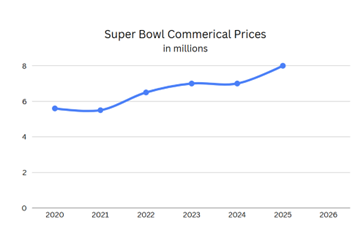
With millions being spent per 30-second ad, some ads resonate with the public over others. But with AI becoming more prevalent in advertising, viewers may notice a shift in future Super Bowl commercials.
The growth of AI
With the rapid rise of AI and its integration into the media, SUNY Brockport marketing professor Priyamvadha Rangan helps students utilize AI in professional settings. She explained how AI has changed marketing in recent years.
“The advertising agency has completely transformed in the last four or five years, and with the advent of AI, it’s been insane over the last two years. And there are five reasons for this: advertising, speed, scale, customization and cost. All of it, so many advantages, so if you’re a businessperson it makes sense,” Rangan said.
For companies to spend millions on a single ad, efficiency matters. The main goal of these ads is to sell a product. Now, with AI, it allows marketers to test new methods of messaging. This new messaging is able to tailor to their consumers’ needs and desires faster than any of the traditional methods. While Rangan recognizes AI’s ability to improve a marketing campaign, she also notes the harm it could bring as well.
“As you’re using this, you’re also losing people,” Rangan said. “And at the end of the day, if you don’t have people then does it even matter?”
Rangan explains that any industry, not just technology, can implement AI into selling their products.
“I mean, like, no matter who you are as a company, your advertising is going to talk about the core benefits and key features of your company,” Rangan said.
According to Rangan, AI does change the tools that companies use for their marketing tactics, but the underlying goal still remains the same and that is persuasion.
“We have to stand up and say no,” Rangan said. “And I think right now there is zero regulation on technology companies, and that makes me really worried for where this is going. This, I think, is a universal problem.”
Rangan emphasized that there are issues about the societal impact that AI is currently having, but also the issues that are going to rise in the upcoming years. From job displacement to misinformation, these issues may extend far beyond the 30-second commercials we see on a Super Bowl Sunday.
AI’s normalization
Super Bowl commercials are a cultural phenomenon because of their high viewership. SUNY Brockport sociology professor Kyle Green researched Super Bowl commercials between 2000 and 2010. He specifically assessed the ads’ themes of gender roles, especially masculinity, and how these themes are used to sell products.
“With every other event, when there’s an ad you simply, walk away, or we avoid it with streaming services. But for the Super Bowl, it’s actually live. You know that there are eyes on the screen,” Green said.
Unlike digital ads that can be skipped, the Super Bowl commercials cannot be skipped and demand collective attention. With that, the shared viewing experience amplifies whatever message is being presented.
“What it actually shows is these companies [that are using AI] are trying to convince investors that they are on safe ground, inevitable and that they’re trying to normalize that AI is a thing that we should all be accepting as part of our lives,” Green said.
By having AI as the forefront of advertising, companies are not just selling their products–they are making a name for themselves and selling acceptance into AI.
“And so, the Svedka company went that route. They were like, if we go completely AI, we know we’re going to anger some people, but at least people are going to pay attention to this,” Green said.
Green expressed he was discomforted by how normalized AI has become in Super Bowl advertising.
“The big takeaway for me was just how much companies, I know I’m repeating this word, but just like, normalized. You have to normalize new technology,” said Green. “They were less about this cool new thing, but more about being this thing that is always with you.”
For Green and others, not all reactions were comfortable or accepting. Some viewers, like Green, noticed that there is something about AI that is not human and making hard for the viewers to connect with the product.
“There is more of a psychological concept when I think of AI right now, uncanny valley,” Green said. “So, I think that technology has reached this point where when something that is very close to the real thing, it can be more disturbing than when it is far away.”
According to Green, when there is discomfort with a product, or in this case, a hyper-realistic ad, audiences may be deterred.
“We are social creatures. We learn to read each other and to learn each other’s responses, and when we see this thing that is lacking some sort of depth that’s hard to point to as social creatures, I think that bothers us,” Green said.
Uneasy acceptance of AI
For some viewers, the AI-induced commercials left strong impressions, like for junior sports management major Dylan LaForce. LaForce grew up with football; he never missed watching a Super Bowl game.
“I thought that it was absolutely insane, just based on the pure volume of AI commercials,” LaForce said. “I can also see why they did this though; our world is changing very quickly, and AI is becoming more and more relevant each day. So, these companies take advantage of one of the biggest talking points in our current society to gain the most amount of attention.”
LaForce pointed out that attention to things does not always equate to comfort.
“The [ads] felt different for sure. I mean most people are looking for that new hit product or just looking to have a laugh while watching the commercials,” LaForce said. “So, seeing all of the AI commercials definitely put a sense of uneasiness to a lot of consumers. I just feel like some of the usual feel-good ads were missing and just replaced with AI.”
While LaForce acknowledged that the commercials were different, the ads still had a human connection sense to them. He said they weren’t hollow, but they just had a strange tone to them.
“I wouldn’t necessarily say that the ads felt soulless, perhaps, but the ads did feel genuinely weird and sort of uncanny. I mean, I guess my main takeaway is that I think that it is reasonable for these companies to use AI ads and air them to go along with the way our world’s trajectory is headed,” LaForce said.
Looking ahead
If the Super Bowl is a snapshot of American culture, then these new AI involved commercials may be a preview of what is to come.
AI is no longer seen as futuristic; it is now present. These algorithms will continue to grow smarter and indecipherable.
The question is no longer whether AI belongs in advertising, but how much of the human sense and touch will remain. Whether the audience continues to feel something, that remains the real test.