










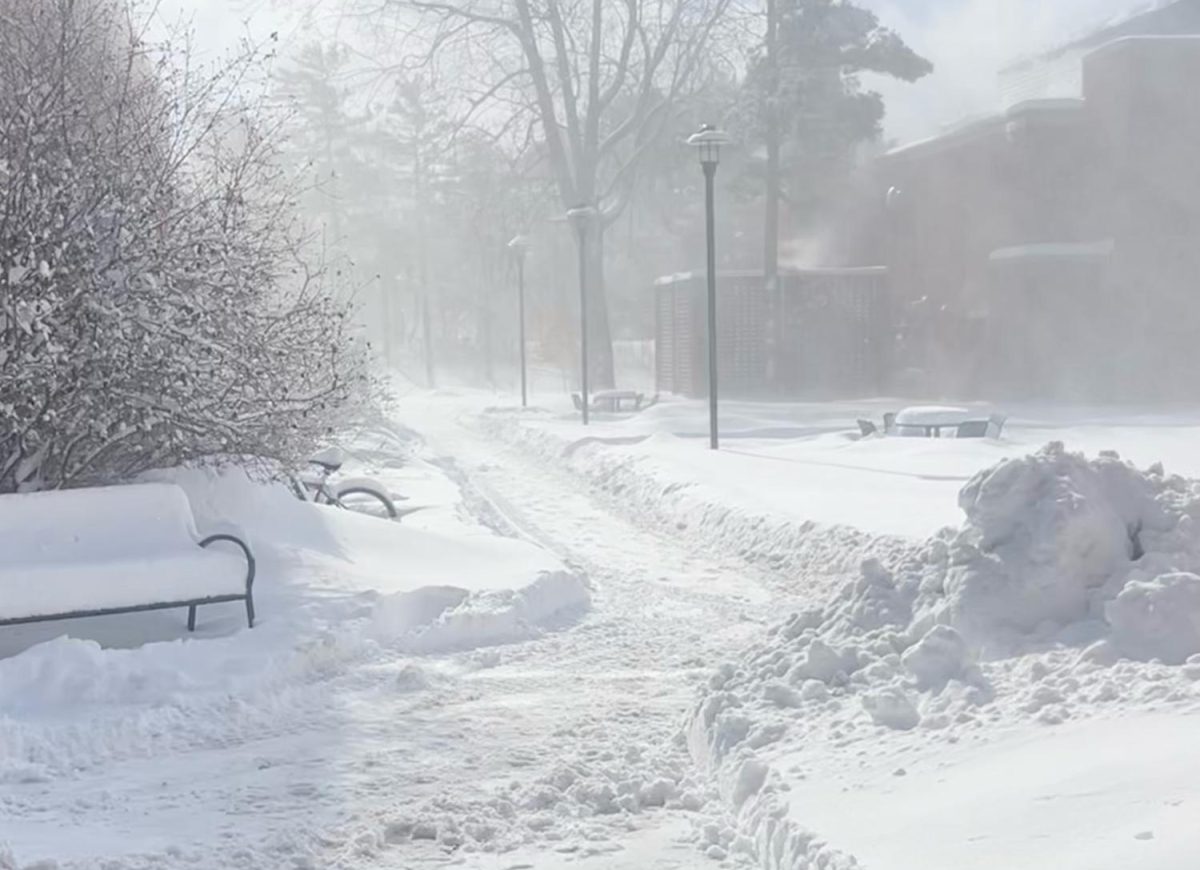
This winter, Western New York faced record-breaking amounts of snow. SUNY Brockport welcomed the start of the spring semester with a snow day, as the village of Brockport received eight inches of snow.
Since then, the campus has accumulated more snow, and students have had to navigate getting to their classes despite the conditions. For some students, the snow has been more than an inconvenience – it has made the campus inaccessible, creating new access barriers for them and preventing them from completing day-to-day tasks.
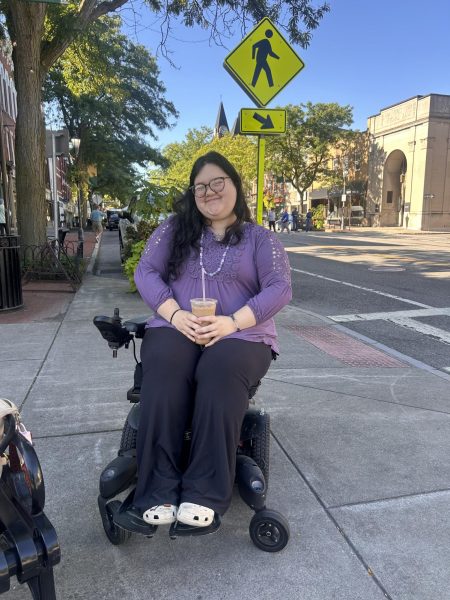
One of these students is junior Emilee Ramirez. Ramirez has several chronic conditions, including posture orthostatic tachycardia syndrome, or POTS. Because of this, she uses an electric wheelchair.
The high amounts of snow the campus has been receiving has made it difficult for her to get to her classes as well as access other campus resources. On the first day of classes, she subplexed her hip attempting to push her chair out of the snow after it got stuck on her way to Holmes Hall from her on-campus townhome.
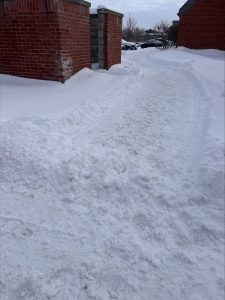
“I’m going to take my chair out to go to class, and I literally cannot because there’s multiple inches of snow everywhere I was,” Ramirez said. “Like, why hadn’t [maintenance] plowed yet, I would assume they would have plowed by now.”
After not finding a route to Holmes that wasn’t covered in snow, she called campus maintenance.
“Two gentlemen showed up, and they said some very odd things,” Ramirez said. “They told me, ‘Well, we don’t know [to plow the route] unless you guys tell us that you guys are here.’ Do I need to tell you to plow because I’m in a wheelchair? Because I saw multiple people slipping and sliding. It’s not just me that’s struggling.”
After telling Ramirez they would plow the area by the townhomes, they drove to the other side of campus.
Ramirez was able to get through the snow on her chair by taking a diverted path, going downhill and driving over the train tracks. Even after reaching the other side of campus, the path was not clear enough for her to get to class in Holmes Hall. Ramirez’s chair got stuck in front of McFarlane Hall and a maintenance employee pushed her from McFarlane to Holmes.
“My wheels kept skidding, and I could feel the snow and ice crunching underneath my chair,” Ramirez said. “But I had no other option. I literally couldn’t get out.”
Attempts to drive through the snow took a toll on Ramirez’s chair. The snow damage was forcing her chair to slow down without her control, something she refers to as “turtle mode,” a reference to the turtle icon that displays when her chair slows down.
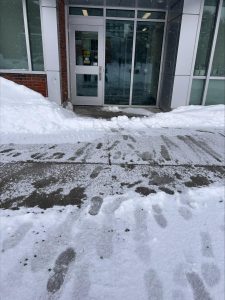
After continued issues navigating campus in the snow, Ramirez met with someone from Student Accessibility Services, or SAS. During the meeting (which Ramirez was late to because the entrance to SAS wasn’t thoroughly plowed), Ramirez was asked to draw her daily route on a paper map of the campus so SAS could send it to Facilities Maintenance and Operations.
Instead of plowing when the map was submitted, a bus was sent to pick up Ramirez and drop her off at her night class.
“[The bus driver] had never opened the door to the lift or used the lift ever, like ever, on that bus,” Ramirez said. “So I automatically start getting a little nervous, because they lift you pretty high up in the air on bus lifts, and if you fall, you can get seriously hurt. He literally said to my face, ‘Yeah, you’re gonna have to teach me how to use this thing.’”
After struggling to get Ramirez and her chair on the bus, the bus driver failed to secure her and her chair because he couldn’t find the tie-downs needed.
“I could have got seriously injured if we were in an accident,” Ramirez said. “But we took off to Holmes Hall, where there’s not a plowed place or a sidewalk where I was able to get safely off the bus so the ramp would be level.”
The bus had to go around the block to find a spot to drop Ramirez off. These delays caused Ramirez to be almost half an hour late to her class.
Through the following weeks, Ramirez continued to face difficulty using her damaged chair to get to class. There was one instance when her chair was entering into “turtle mode” and slowing down and speeding back up so frequently, it caused her backpack to fall off her chair without her realizing. The backpack held her iPad and laptop. While another student found it and returned it to her, Ramirez said she is still frustrated that she must advocate for herself, instead of the campus being accessible.
“All this weight that shouldn’t be on me is on my shoulders, instead of things being properly handled and having proper things enforced to make sure that we’re prepared for winter storms,” Ramirez said. “It’s hard to be your only advocate.”
SUNY Brockport has many resources that not only connect students with accessible services but also advocate for more awareness about accessibility for the greater campus community.
This includes the university’s Committee on Accessibility, known as the CoA. Founded in the fall of 2015, the CoA lists their mission and goals on SUNY Brockport’s website as “promoting accessibility, increasing awareness and creating coursework for students to study disability.”
College of Education and Health Assistant Dean Jessica Sniatecki was one of the founding members and a previous chair of the CoA. Sniatecki has been involved with accessibility initiatives both at the Brockport and SUNY level. A frequent challenge Sniatecki identified when addressing accessibility on campus is ableism. When educating the campus community on accessibility, she emphasizes the importance of having a proactive mindset over a reactive mindset.
“It’s often a much broader array of folks that have potential benefits from that then don’t, and it’s not just folks with disabilities,” Sniatecki said. “When we widen the lens, sometimes that helps.”
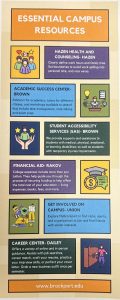
Sniatecki said some examples of accessibility initiatives that benefited a wider community of people include adding close-captions to videos or gender-inclusive restrooms. She explains that approaching accessibility in a proactive way not only aids students with registered disabilities, but also students who are struggling with disabilities that are not officially registered through the university.
“If we are designing things to be accessible from the start, we also are providing that same access to some students that might need it but might not disclose to us that they need it,” Sniatecki said.
SAS, located in the Academic Success Center, works to connect students, both with and without registered disabilities, to a variety of resources. Director of SAS Nicole Mucica says that even if a student doesn’t have a university-registered disability, her office can still put them in contact with resources to help them. Mucicia says that SAS works with other offices, like Brockport Auxiliary Services Corporation (BASC), Parking and Transportation, and Facilities Maintenance and Operations, to collaborate on accessible solutions to campus issues that don’t directly fall under SAS’ jurisdiction.
For snow removal, Mucica and SAS have worked closely with Director of Facilities Maintenance and Operations Julie Caswell. They have collaborated on solutions to help students have access to campus. For Ramirez, the solution was having her draw out her route on a map of campus so facilities knew where to prioritize plowing. Caswell also met with a student with visual impairment to walk their route with them, so she could be aware of what access barriers the snow created for them.
“It was helpful for her to see what are the sensory things they need on the ground, and what are the paths that they’re taking,” Mucica said. “After she met with them, she told me that she had a better understanding of what they needed to do to clear the path for them.”
To promote campus accessibility and communication with facilities, the CoA created stickers that list the facilities hotline and placed them near push pad door openers. This allows members of the campus community to report access barriers so they can get addressed as soon as possible.
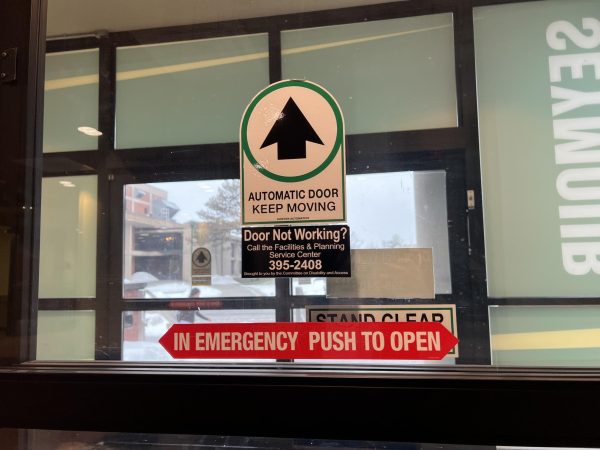
Through collaboration and communication, SAS and CoA have been working to find accessible solutions to improve campus, especially with the continued snowfall.
“Winter has been brutal,” Mucica said. “If campus is open, we need to make sure that the campus is accessible. And I know that it’s been frustrating for some students, but I can assure you that I know from my conversations with facilities, they’re working around the clock to do what they can.”